


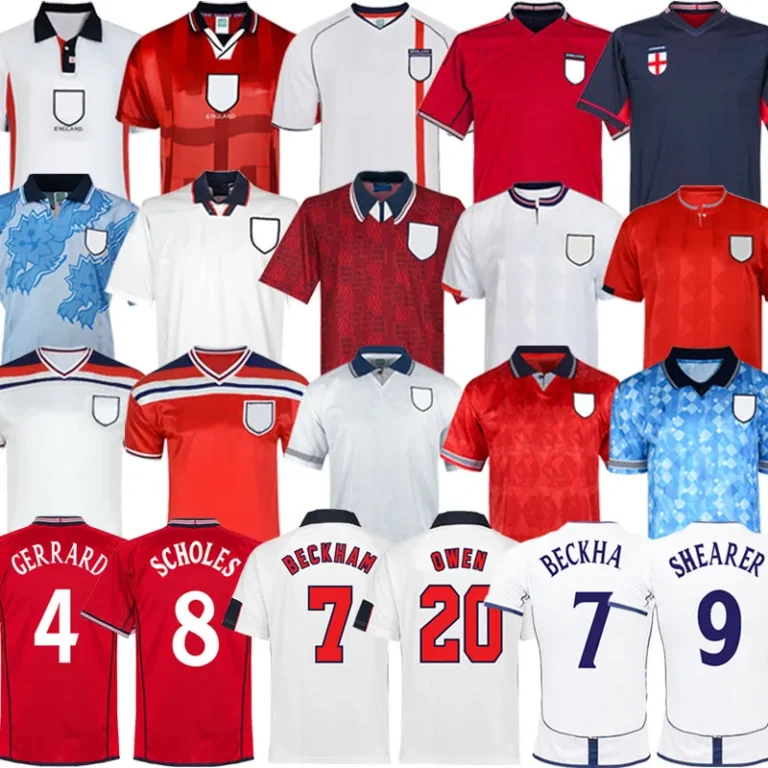
The most legendary England football shirt has to be the first one: 1966 World Cup, the one Bobby Moore held aloft. It is the formant for almost every ranking, simply because no other England shirt is tied to such a momentous result. The rest of the list is built upon a handful of cult favourites; the Italia 90 home shirt with its subtle pattern, the extravagant Euro 96 effort, and the classic 1982, Admiral nightmare. It really boils down to a debate about whether any kind of silverware, a nice design or a touch of nostalgia should take precedence.
And for England, the prevailing choice remains any of what I just said. The reason why the England shirt history is so compelling though is that it only has one real trophy to its name. The rankings cannot simply be based on silverware the way that they are in Brazil or Germany. Instead, the most loved English shirts are ranked based on design, the tournament memories which they hold and the kit manufacturer periods which influence how they look, which is why an England shirt from a tournament where England were never champions can still rank near the top.
Which England Shirt Is the Most Iconic of All Time
The 1966 red shirt is the undisputed number one, and it is worth exploring why, beyond the obvious. As England generally play in white, the final red change strip worn against West Germany in the 1966 FIFA World Cup Final will forever be identifiable with the only World Cup the country has won, elevating a secondary colour to a single historical appearance to number one.
The plain red shirt with the three lions crest and number on the back has become timeless. That shirt is just one of those templates that England has revisited time and time again and, of course, reissued red on more than one occasion to remind us of 1966.
The emotional association is so strong that even re-issuing an away or change kit in red that was once white still has the same effect over 40 years later, a feat that not many nations can boast of. Second, the white home shirt in that tournament matters, but the red one catches the moment, and that is what the entire ranking ultimately hinges on. For England, the shirt that triumphs is nearly always the one fused with the memory, rather than the one that is ideal on paper.
How the Kit Manufacturer Era Shaped England’s Shirts
England’s shirt story tracks neatly across the companies that made them. The Admiral era of the late 1970s and early 1980s introduced the first genuinely branded, commercially designed England kits, with the 1982 World Cup shirt and its red and blue shoulder striping becoming a defining look of the period. That was the moment the England shirt stopped being plain kit and started being a designed product people wanted to own.
Umbro then took over for a long and celebrated run, producing the Italia 90 home shirt with its faint shadow pattern and the unmistakable Euro 96 design worn during the home tournament that gripped the country. Those Umbro shirts are the ones middle-aged fans are most sentimental about, and browsing through the classic England national team kits of that period shows just how much the design language shifted from one decade to the next. The 1990s in particular produced shirts now treated as genuine design classics.
Nike took on the kit in 2013 and has leaned into both clean modern templates and deliberate throwbacks, including red away shirts that nod straight back to 1966. Each manufacturer switch resets the design language, which is part of why England shirts feel like they belong to distinct chapters rather than one continuous line.
Why Tournament Memories Decide the Rankings More Than Design
For most supporters, the shirt they place first is the one they had on at a tournament that personally meant more than any other. Euro 96 remains perched high on a thousand polls not because it has the greatest design, but because it is inextricably linked to the summer of football coming home, penalty despair against Germany and a nation united (albeit for a brief while) behind the team. The shirt became a symbol of that shared experience.
It is the same with Italia 90, linked to the run to the semi-finals, the penalty shoot-out exit and those pictures that defined a generation’s relationship with the national team. When documenting fandom, it has long been thought that supporters’ favourite kits are inextricably connected to the time in their life that they belonged to. Because of this why two people can rank England shirts in totally different orders, with one from before they were born, higher than the one they used to love as a teenager during a major international tournament.
What These Iconic Shirts Cost and How to Collect Them
On the playing field, yet feeling the fabric in your hand is its own reward. A standard official England replica will cost something in the region of pounds 70-90, with authentic player-spec items going more, and last season’s kit folk price fell after the squad was kitted out for a new campaign. The real holy grails of vintage football shirts are the authentic historic shirts, which can be bought for a few hundred pounds or so in mint condition from the ’80s or ’90s, and can command much more at auction for prototypes played in by your idols.
The ’66 originals is a class unto themselves, because match-worn shirts from that final are historical antiquities rather than memorabilia, and the few that are available to buy in the marketplace bring extraordinary prices. The attainable alternative for most is a high-quality reproduction or an authentic vintage replica in good condition, enabling you to wear the spirit of the great teams without shelling out collector income for delicate originals.
